Annual Reports
Charter Communications, Inc.'s annual reports contain management's most considered account of the business. These are the sections, passages and visual pages worth opening in the originals preserved in Sources.
Charter Communications, Inc. — FY2025 Annual Report (Form 10-K) — FY2025
The current business in management's words, written while two transformative deals - Cox and Liberty Broadband - are still pending. · Open the full document →
Item 1. Business. — p. 7 · Read the full section →
Management's own framing of the strategy: sell more products per relationship, cut service transactions, lower churn.
The stated strategy and the churn-to-profitability logic behind it.
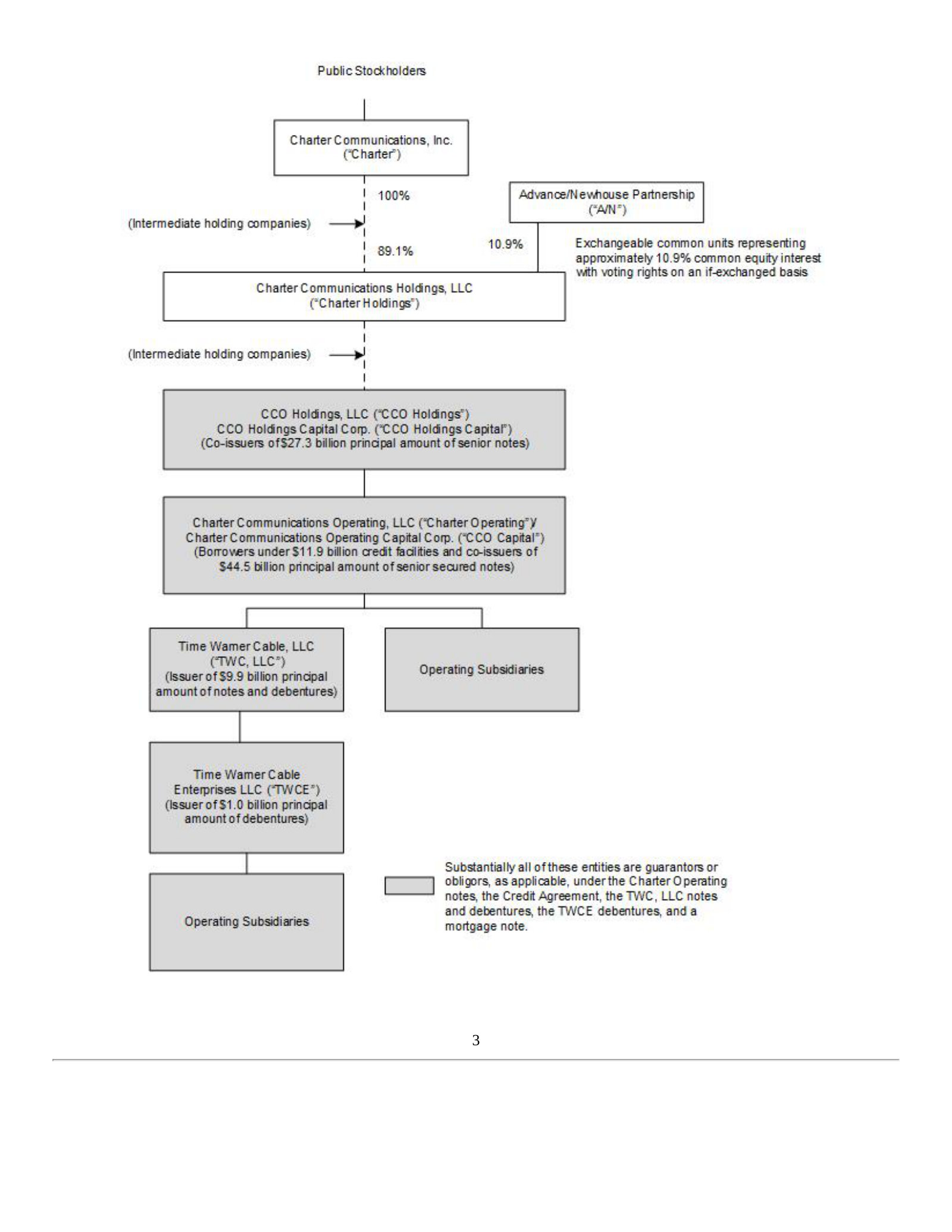
We are a leading broadband connectivity company with services available to 58 million homes and small to large businesses across 41 states through our Spectrum brand. Founded in 1993, we have evolved from providing cable TV to streaming, and from high-speed Internet to a converged broadband, WiFi and mobile experience. […] Our strategy is focused on utilizing our fiber-powered network to deliver high-quality, competitively priced products, with outstanding service, allowing us to increase both the number of customers we serve over our network and the number of products we sell to each customer. This combination also reduces the number of service transactions we perform per relationship, yielding higher customer satisfaction and lower customer churn, which results in lower costs to acquire and serve customers and drives greater profitability.
p. 7 · Read in context →
Products and Services — p. 12 · Read the full section →
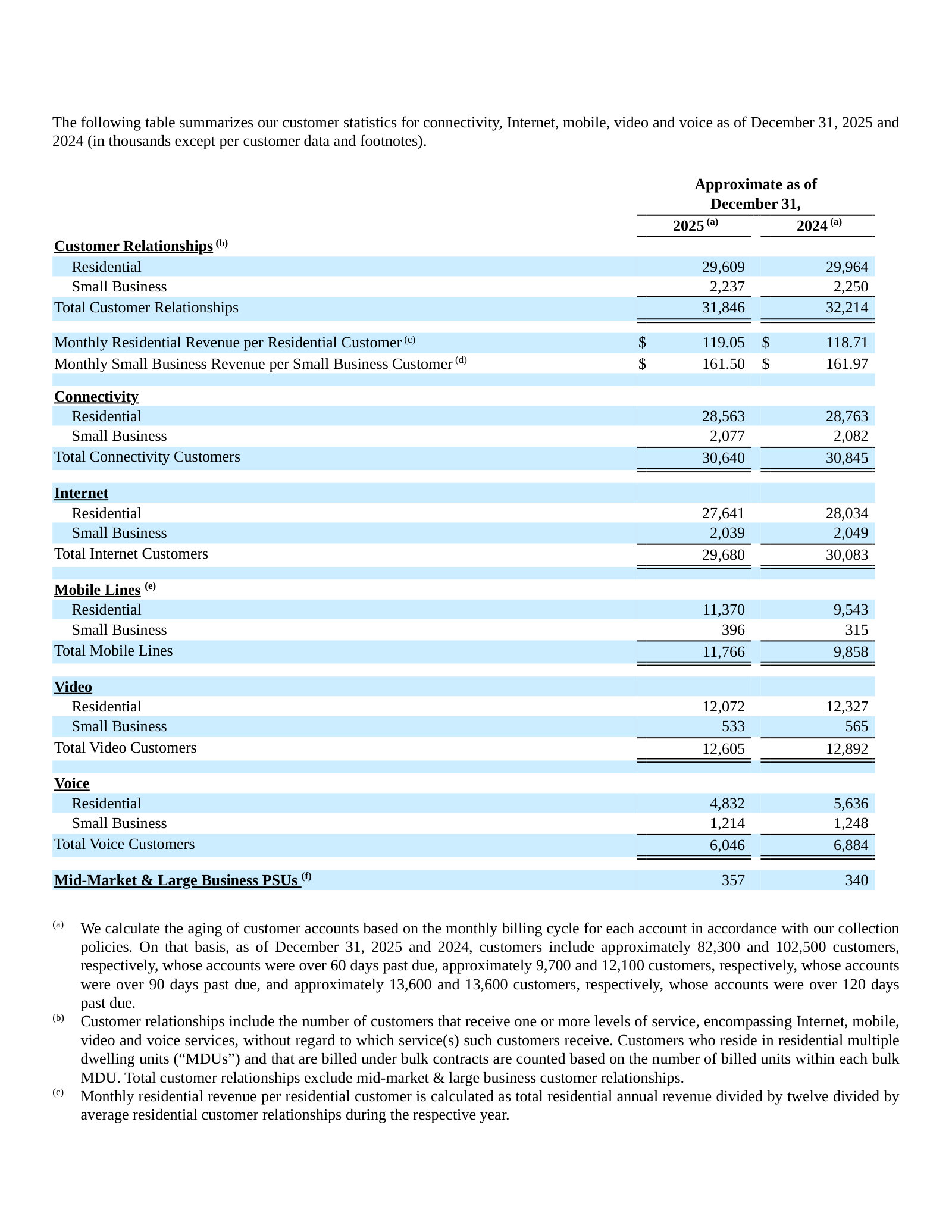
The customer-metric definitions were rewritten in Q4 2025; this table is the base for every per-customer number Charter reports.
What Charter sells, and the fourth-quarter 2025 revision to how customers are counted.
We offer our customers subscription-based Internet, mobile, video and voice services, with prices and related charges based on the types of service selected, whether the services are sold as a “bundle” or on an individual basis, and based on the equipment necessary to receive our services. […] To better reflect the converged and integrated nature of our business and operations, in the fourth quarter of 2025, we revised our customer relationship statistics to include all mobile customers, including mobile-only customers, and have added information on total connectivity customers, which represent all customers receiving our Internet and/or mobile connectivity services. In addition, in the fourth quarter of 2025, certain reporting policies related to mobile lines were revised to better align with other Charter services. Other minor changes were made to small business Internet customers and mid-market & large business primary service units (“PSUs”) to standardize reporting methodologies. Prior periods have been revised accordingly.
p. 12 · Read in context →
Competition — p. 27 · Read the full section →
Names the overlap in numbers - AT&T and Verizon fiber across 27% and 16% of the footprint - rather than in the abstract.
The fiber and fixed-wireless overlap Charter faces on residential Internet.
Our residential Internet service faces competition across our footprint from fiber-to-the-home ("FTTH"), fixed wireless broadband, Internet delivered via satellite and DSL services. […] Several FTTH competitors deliver 1 Gbps broadband speed (and some deliver multi Gbps) in at least a portion of their footprints which overlap our footprint. AT&T Inc. ("AT&T") and Verizon are our primary FTTH competitors. We face terrestrial broadband Internet (defined by the Federal Communications Commission (“FCC”) as at least 100 Mbps) competition from AT&T and Verizon in approximately 27% and 16% of our operating footprint, respectively. […] Several national mobile network operators offer long-term evolution (“LTE”) or 5G delivered cell phone home Internet service (fixed wireless access from cell phone towers) in our markets.
p. 27 · Read in context →
Liberty Broadband Combination — p. 31 · Read the full section →
Charter is absorbing its largest shareholder; the terms and what comes with the deal are set out here.
What Charter takes on: 41.5m of its own shares, $1.8 billion of Liberty debt, $180 million of preferred.
As of December 31, 2025, Liberty Broadband’s principal assets consist of approximately 41.5 million shares of Charter Class A common stock. […] Liberty Broadband has debt of $1.8 billion as of September 30, 2025 that will be repaid prior to closing or assumed by Charter, and $180 million in aggregate liquidation preference of Liberty Broadband preferred stock that will be converted into an equal amount of Charter preferred stock in the Liberty Broadband Combination. The companies currently expect the transaction to close contemporaneously with the closing of the Cox Transactions, unless otherwise agreed, subject to customary closing conditions.
p. 31 · Read in context →
Cox Transactions — p. 31 · Read the full section →
The larger of the two pending deals, and the one that resets leverage - structure and assumed debt in management's words.
The three-part structure of the Cox deal.
On May 16, 2025, Charter, Charter Holdings, and Cox Enterprises, Inc. (“Cox Enterprises”) entered into a Transaction Agreement (the “Transaction Agreement”) pursuant to which (i) Cox Enterprises will sell and transfer to Charter 100% of the equity interests of certain subsidiaries of Cox Communications, Inc. (“Cox Communications”) that conduct Cox Communications’ commercial fiber and managed IT and cloud services businesses (the “Equity Sale”), (ii) Cox Enterprises will contribute the equity interests of Cox Communications and certain other assets (other than certain excluded assets) primarily related to Cox Communications’ residential cable business to Charter Holdings (the “Contribution”), and (iii) Cox Enterprises will pay $1.00 to Charter (collectively, the “Cox Transactions”).
p. 31 · Read in context →
The debt that comes with it: approximately $12.6 billion of Cox net debt and finance leases.
The combined entity will assume Cox Communications’ approximately $12.6 billion in outstanding net debt and finance leases (assumed debt is on a pro forma basis contemplating Cox Communications refinancing of debt maturities occurring between signing and closing of the Cox Transactions).
p. 33 · Read in context →
Item 1A. Risk Factors. — p. 44 · Read the full section →
Two risks that are specific and quantified for Charter: the competitive overlap, and the leverage funding the Cox deal.
Competition in management's words, across Internet, mobile, voice and advertising.
We operate in a very competitive business environment, which affects our ability to attract and retain customers and can adversely affect our business, operations and financial results. […] The industry in which we operate is highly competitive and has become more so in recent years. In some instances, we compete against companies with fewer regulatory burdens, better access to financing and greater and more favorable brand name recognition. […] Our Internet service faces competition from other companies’ FTTH, cell phone home Internet service, Internet delivered via satellite and DSL services. Various operators offer wireless Internet services delivered over networks which they continue to enhance to deliver faster speeds and also continue to expand 5G mobile services as they seek to offer converged connectivity services similar to ours. Our mobile and voice services compete with wireless and wireline phone providers, as well as other forms of communication, such as text, instant messaging, social networking services, video conferencing and email. Competition from these companies, including intensive marketing efforts with aggressive pricing, may have an adverse impact on our ability to attract and retain customers.
p. 44 · Read in context →
$94.6 billion of principal at 4.15x Adjusted EBITDA, before the Cox debt arrives.
We have a significant amount of debt and expect to incur significant additional debt, including secured debt, in the future, as well as additional debt in connection with the Cox Transactions and Liberty Broadband Combination, which could adversely affect our financial condition and our ability to react to changes in our business. […] We have a significant amount of debt, with total principal amount of approximately $94.6 billion and a leverage ratio of 4.15 times Adjusted EBITDA as of December 31, 2025. […] As part of the Cox Transactions, Charter will fund the $4.0 billion of cash consideration using debt and will assume Cox Communications' approximately $12.6 billion of net debt and finance leases.
p. 52 · Read in context →
Item 7. Management’s Discussion and Analysis of Financial Condition and Results of Operations. — p. 80 · Read the full section →
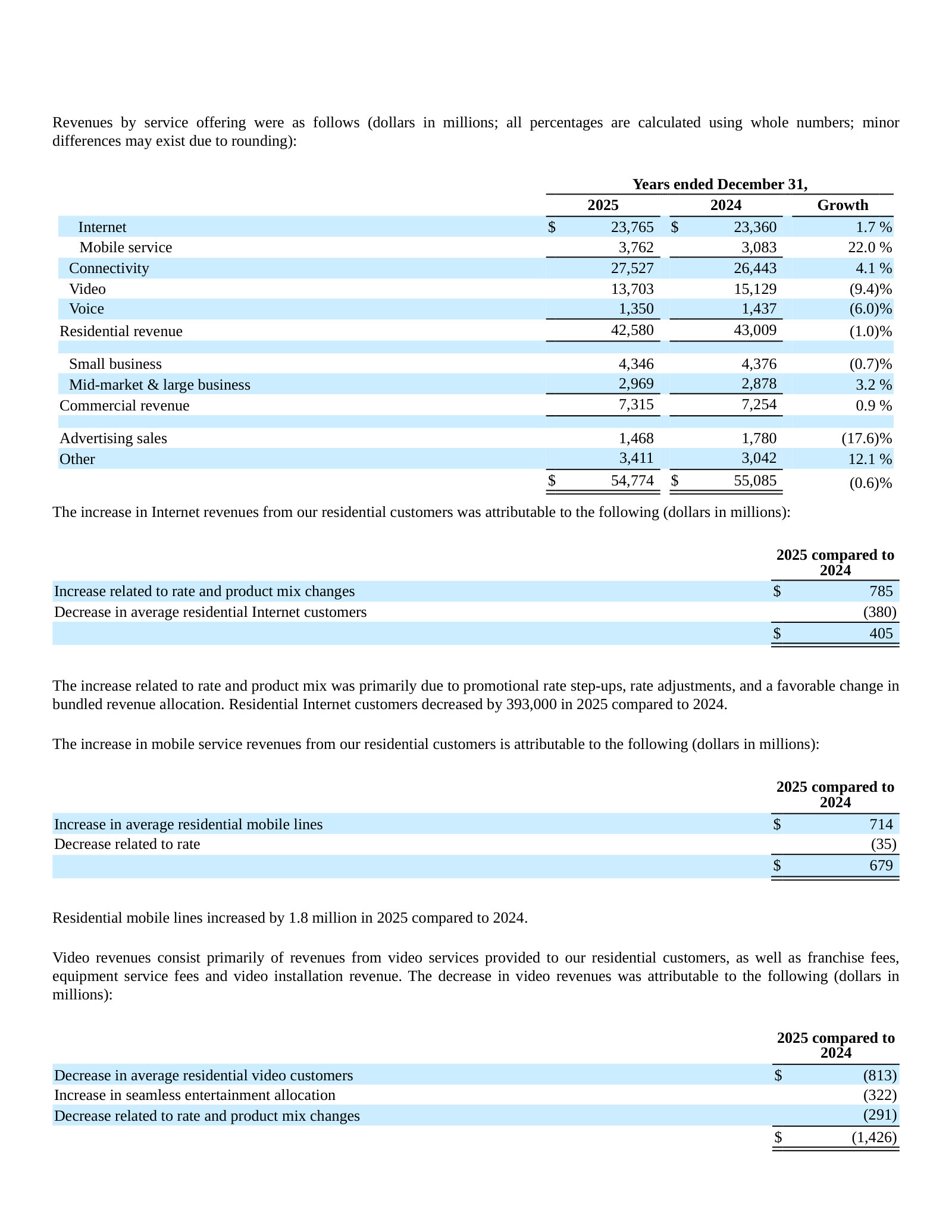
Management on what actually moved 2025: mobile lines up 1.9 million against total revenue down 0.6%.
Valuation and impairment of franchises and goodwill — p. 84 · Read the full section →
$67.5 billion of franchise rights - 44% of assets - carried as indefinite-lived and never amortized; the policy defines the balance sheet.
Why franchise rights are treated as indefinite-lived, and the 2025 impairment headroom.
The carrying value of franchise intangibles as of both December 31, 2025 and 2024 was approximately $67.5 billion (representing 44% and 45% of total assets, respectively), and the carrying value of goodwill as of both December 31, 2025 and 2024 was approximately $29.7 billion (representing 19% and 20% of total assets, respectively). […] Management estimates the fair value of franchise rights at the date of acquisition and determines if the franchise has a finite life or an indefinite life. We have concluded that all of our franchises qualify for indefinite life treatment given that there are no legal, regulatory, contractual, competitive, economic or other factors which limit the period over which these rights will contribute to our cash flows. […] Based on our quantitative analysis, we concluded that the fair value of the franchises in each unit of accounting exceeds the carrying value of such assets by more than 10%.
p. 84 · Read in context →
Liquidity and Capital Resources — p. 96 · Read the full section →
How the debt is actually composed, what free cash flow covers, and where leverage is meant to land after the deals close.
Debt composition, split credit rating, $5.0 billion of free cash flow, and the leverage targets.
We have significant amounts of debt and require significant cash to fund principal and interest payments on our debt. The principal amount of our debt as of December 31, 2025 was $94.6 billion, consisting of $11.9 billion of credit facility debt, $55.4 billion of investment grade senior secured notes and $27.3 billion of high-yield senior unsecured notes. Our split credit rating allows us to access both the investment grade debt and the high yield debt markets. […] Free cash flow was $5.0 billion and $4.3 billion for the years ended December 31, 2025 and 2024, respectively. […] Charter's leverage ratio of net debt to the last twelve months Adjusted EBITDA was 4.15 times as of December 31, 2025. Charter plans to maintain a leverage ratio, pro forma for the closing of the Liberty Broadband Combination near the midpoint of its stated range of 4.0 to 4.5 times Adjusted EBITDA in the period leading up to the Closing, and up to 3.5 times Adjusted EBITDA at the Charter Operating first lien level. Charter plans to adjust its long-term target leverage range after the Closing to 3.5 to 3.75 times Adjusted EBITDA.
p. 96 · Read in context →
Charter Communications, Inc. — FY2024 Annual Report (Form 10-K) — FY2024
Included for one section: the customer statistics on the old definitions, before the Q4 2025 revision restated the base. · Open the full document →
Products and Services — p. 12 · Read the full section →
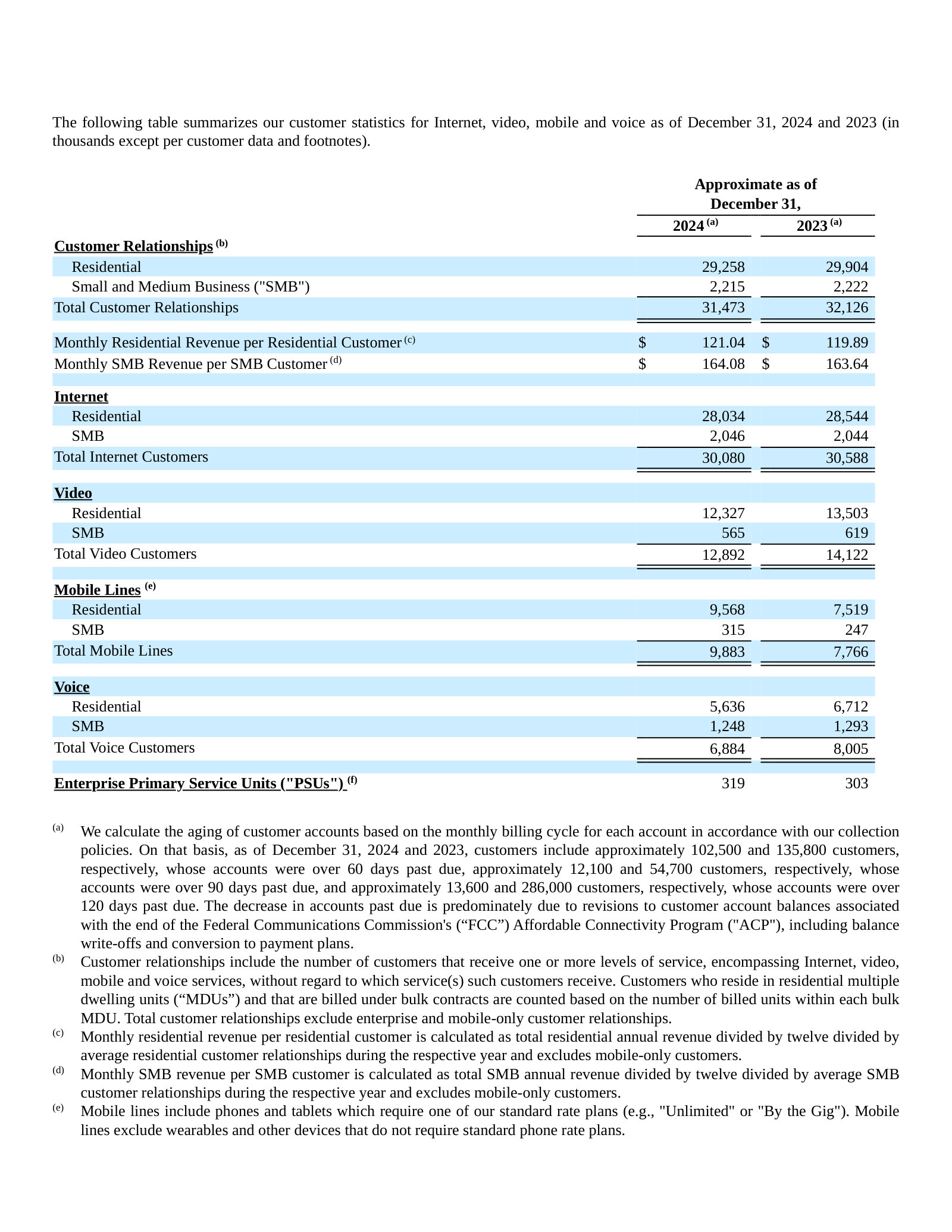
The same table one year earlier on the pre-revision basis - SMB and Enterprise labels, mobile-only customers excluded.
More annual reports
Charter Communications, Inc. — FY2023 Annual Report (Form 10-K) — FY2023 · 174 pages · The last edition written before the Liberty Broadband and Cox transactions were announced - Charter on a standalone basis. · Open →
Charter Communications, Inc. — FY2022 Annual Report (Form 10-K) — FY2022 · 165 pages · First edition to set out the network evolution initiative and the subsidized rural construction build at scale. · Open →
Charter Communications, Inc. — FY2021 Annual Report (Form 10-K) — FY2021 · 181 pages · The pre-build baseline: 15.8 million video customers and 3.6 million mobile lines, before either initiative began. · Open →